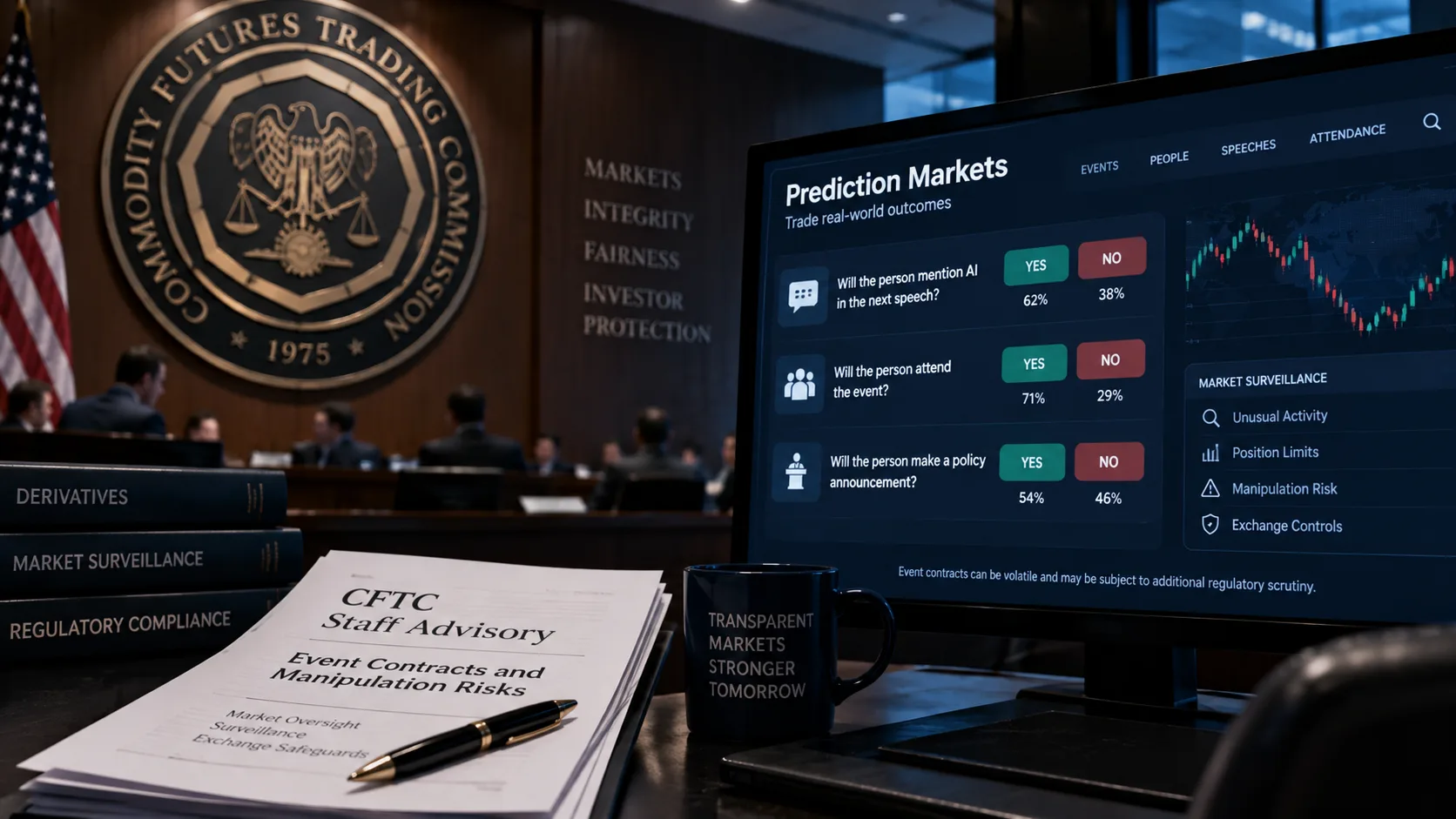
The US Commodity Futures Trading Commission has raised fresh concerns over a niche but growing corner of prediction markets: contracts that settle based on what a specific person says or does.
In a staff advisory issued on September 22, the CFTC’s Division of Market Oversight said so-called “mention markets” present heightened manipulation risks because their outcome can depend on the conduct of a single person rather than on a broader, independently generated event.
What Are Mention Markets?
Mention markets are event contracts that can settle based on whether a named person:
says or mentions a particular word or phrase
attends or appears at an event
interacts with another person
performs another discrete action that determines the contract outcome
Unlike contracts tied to economic data, election results or other external events, a mention contract may be influenced directly by the person whose conduct determines settlement.
That creates a basic integrity problem: the person at the centre of the contract may be able to change the result simply by choosing what to say or do.
CFTC Says Manipulation Risk Is Higher
CFTC staff said these contracts may be particularly vulnerable when the relevant conduct is not independently generated or easily verified.
The advisory does not prohibit mention markets outright. Instead, exchanges seeking to list such contracts are expected to provide a stronger contract-specific analysis showing that the product is not readily susceptible to manipulation.
That requirement flows from Core Principle 3 of the Commodity Exchange Act framework, which requires designated contract markets to avoid listing products that are readily susceptible to manipulation.
Four Areas Exchanges May Need to Address
The CFTC advisory points to several factors exchanges should consider when designing mention-market contracts.
Among them are whether the person controlling the outcome is subject to legal, professional, fiduciary or contractual duties; whether outsiders could pressure or induce the person to influence the contract; whether the underlying action can be independently verified; and whether the exchange has adequate surveillance, position limits and other controls.
The stronger those protections are, the better the case an exchange may have for showing that a particular contract can operate without excessive manipulation risk.
Insider Trading Case Put Mention Markets in Focus
The advisory arrives only weeks after the CFTC settled an insider-trading case involving Gabriel Perez, a former White House teleprompter operator.
According to the CFTC, Perez had advance access to presidential speeches and used that nonpublic information to trade event contracts tied to words or phrases the president might say. The agency said he generated more than $107,500 in profits.
Perez was ordered to disgorge $107,539.02, pay a $65,000 civil penalty, and accept a three-year trading ban. The combined amount was about $172,539.
The case provides a clear example of the risk the new advisory is trying to address: someone with privileged information can have a direct trading advantage before an event becomes public.
Kalshi Already Faced Similar Cases
The CFTC has been tightening its focus on prediction-market conduct throughout 2026.
In February, its Enforcement Division issued a separate advisory after cases involving misuse of nonpublic information and fraud on prediction markets. The regulator specifically reminded market participants that insider trading, manipulation and deceptive conduct remain subject to federal enforcement.
Finance Magnates also reported that Kalshi had removed sports-related mention markets in August following regulatory scrutiny, although contracts tied to political events, earnings calls and live broadcasts remained available.
This Is Not a Ban on Prediction Markets
The regulatory distinction matters.
The September advisory is aimed specifically at contracts where an individual’s own words, appearance or actions can determine settlement. It does not amount to a blanket prohibition on prediction markets or even on all mention markets.
The CFTC expressly said the advisory creates no new legal obligations and represents the views of Division of Market Oversight staff rather than necessarily the Commission itself.
Why This Matters for Kalshi and Other Platforms
For regulated prediction-market platforms, the advisory raises the compliance burden around certain product designs.
A contract based on an independently observable event is easier to defend than one where a speaker, executive, athlete or official can knowingly influence the result.
That could push exchanges toward stricter surveillance, smaller position limits, restricted-trader lists and stronger controls around people who may possess advance information. Finance Magnates reported that the advisory also points to monitoring trades placed shortly before relevant information becomes public.
What Happens Next
Prediction markets remain an active area of US regulatory development.
Earlier in 2026, the CFTC withdrew a prior event-contract proposal and said it planned a new rulemaking approach instead. The agency has also continued asserting federal jurisdiction over prediction markets while pursuing enforcement cases involving manipulation and misuse of confidential information.
For platforms such as Kalshi and their competitors, the message from staff is increasingly clear: innovation may continue, but contracts whose outcomes can be directly influenced by identifiable individuals will face closer scrutiny.