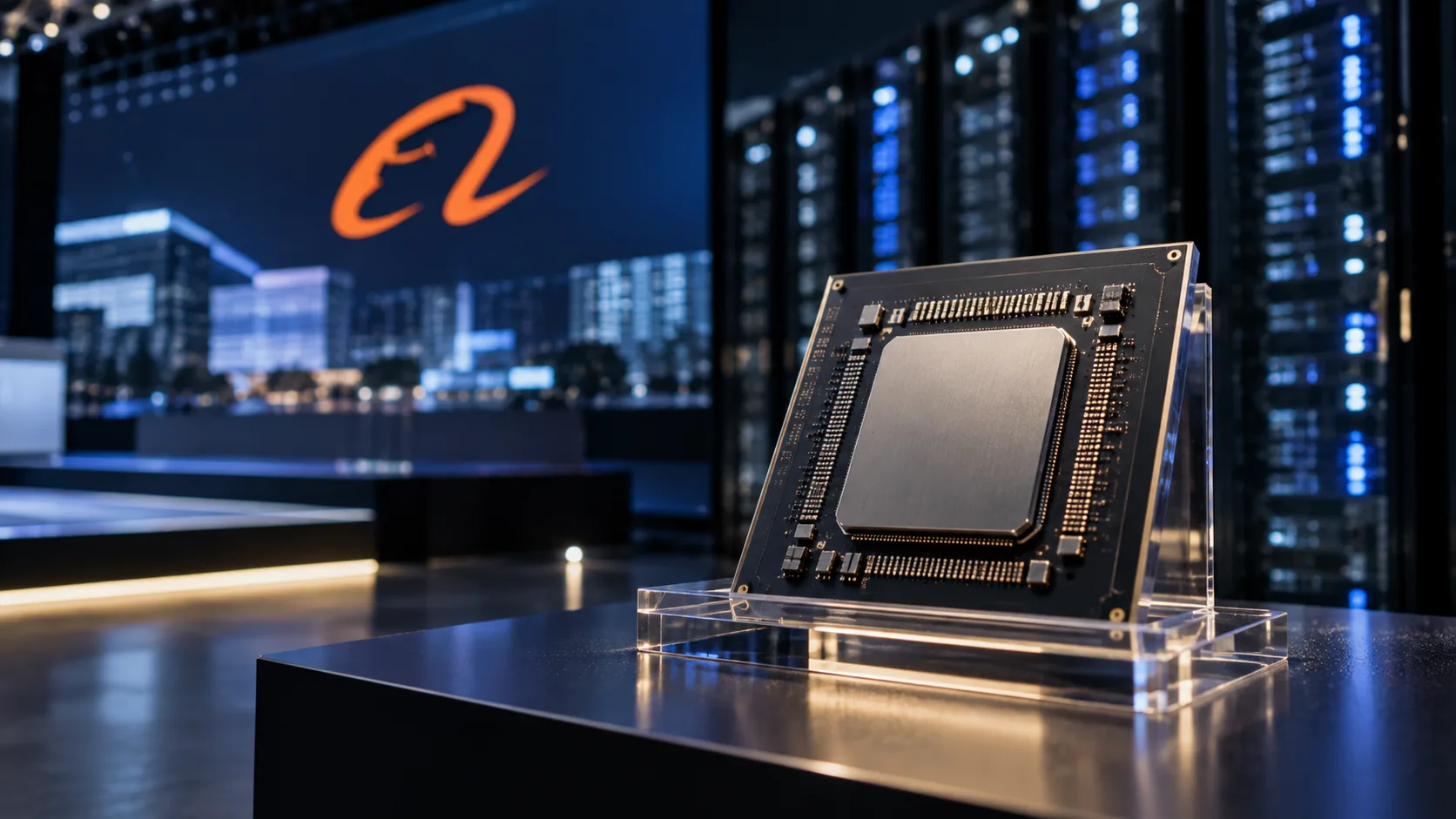
Alibaba has stepped up its artificial intelligence push with the launch of the Zhenwu V900, a new accelerator chip the company describes as the most powerful AI processor currently developed in China.
The chip was unveiled by Alibaba CEO Eddie Wu at the company’s annual Apsara Conference in Hangzhou, alongside broader plans covering AI models, semiconductors and data centre expansion.
Zhenwu V900 Delivers Three Times More Performance
Alibaba said the Zhenwu V900 offers roughly three times the performance of its previous-generation Zhenwu M890 chip.
The company also said the new processor can be connected in clusters of up to 500,000 chips, giving Alibaba the scale needed to train and run increasingly large AI models.
The V900 is expected to enter mass production and commercial release in the first quarter of 2027.
Alibaba Plans AI Model With Up to 10 Trillion Parameters
The chip announcement was only one part of Alibaba’s larger AI roadmap.
Wu said Alibaba’s Qwen team plans to develop future models containing between 5 trillion and 10 trillion parameters, compared with around 2.4 trillion parameters in its current flagship Qwen 3.8 Max model.
Alibaba said future versions of Qwen, including Qwen 4.5 and Qwen 5, are expected to scale toward that range.
The company believes larger models could help handle more complex tasks requiring longer reasoning and greater computational capacity.
Alibaba Targets 20GW of Data Centre Capacity
Alibaba is also planning a major expansion of its cloud infrastructure.
The company said it wants Alibaba Cloud’s global data centre capacity to exceed 20 gigawatts by 2032 as demand for AI computing continues to rise.
Wu described customer demand for AI computing as exceptionally strong, although he acknowledged that supply-chain constraints are limiting how quickly Alibaba can expand capacity.
That infrastructure buildout is significant because cutting-edge AI models require enormous amounts of computing power, energy and semiconductor capacity.
Alibaba Shares Rally on AI Expansion Plans
Investors reacted positively to the announcements.
Alibaba’s Hong Kong-listed shares rose around 5.1%, reaching their highest level in approximately one month, according to Reuters.
Investing.com separately reported gains in Alibaba’s US-listed shares in premarket trading following the announcement.
The rally suggests investors are increasingly viewing Alibaba not only as an e-commerce giant but also as a major AI infrastructure and cloud computing player.
China Pushes for More Homegrown AI Chips
Alibaba’s chip strategy also comes as Chinese technology companies accelerate efforts to develop domestic alternatives to foreign AI processors.
Reuters reported that this push has intensified amid tighter US restrictions on exports of advanced semiconductor technology to China.
Alibaba is competing in this market alongside Chinese technology companies including Huawei and other domestic chip developers.
The bigger strategic goal is clear: reduce reliance on imported processors while building a full AI ecosystem spanning models, chips, cloud computing and data centres.
Why the Zhenwu V900 Matters
The Zhenwu V900 is important because AI competition is increasingly shifting beyond software models alone.
The companies that can control both AI software and the computing infrastructure underneath it may gain a significant advantage as demand for AI services expands.
Alibaba now has ambitions across almost every major layer of the AI stack:
AI models through Qwen
AI processors through T-Head
Cloud infrastructure through Alibaba Cloud
Large-scale data centres
Enterprise AI services
That vertical integration could give Alibaba more control over costs and supply as global demand for AI computing continues to grow.
What Investors Should Watch Next
The key questions are whether Alibaba can move the V900 into mass production on schedule, scale its data centre network efficiently and maintain strong growth in Alibaba Cloud.
Investors will also be watching how quickly Alibaba can close the performance gap with global AI chip leaders and whether Chinese customers increasingly adopt domestic alternatives.
For now, the market reaction shows that investors are taking Alibaba’s AI ambitions seriously.